
PPWR and Digital Product Passports: What Fashion Brands Actually Need to Do
Two pieces of EU law get discussed as though they are one deadline. They are not. One applies now. The other does not apply to clothing at all yet.
Getting the distinction straight saves a lot of unnecessary artwork spend, and stops brands solving problems that do not exist while missing the ones that do.
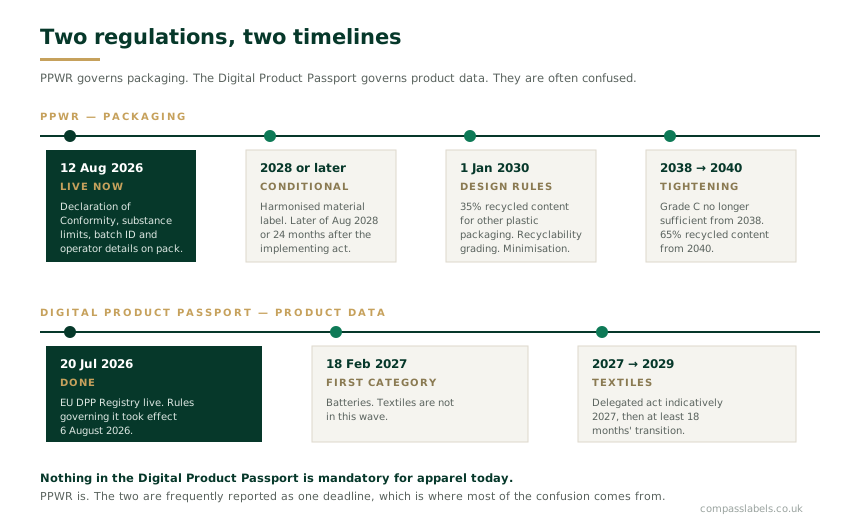
PPWR: live as of 12 August 2026
The Packaging and Packaging Waste Regulation — Regulation (EU) 2025/40 — replaced the old Packaging Directive and became generally applicable on 12 August 2026. It applies directly in all 27 member states, with no national transposition and no grace period for stock produced before the date.
For a fashion brand, the packaging items in scope are more numerous than people expect:
- Polybags — plastic packaging, and the highest-exposure item
- Swing tags — Recital 13 confirms that labels hung directly on or affixed to a product count as packaging
- Tag locks and strings — packaging components
- Tissue paper, zip bags, cartons — packaging
- Woven and sewn-in care labels — not packaging. A label sewn into a garment is an integral part of the product and sits outside the definition
That last point is worth holding on to. Care and woven labels belong in the textile compliance lane, not the packaging one, and separating them keeps documentation clean.
What is required today
- An EU Declaration of Conformity for each packaging type, with technical documentation behind it.
- Substance limits. Lead, cadmium, mercury and hexavalent chromium combined must not exceed 100 mg/kg. Substances of concern must be minimised.
- Identification on pack. A type, batch or serial number that allows the packaging to be identified and tied back to its Declaration of Conformity. An existing GS1 barcode will often satisfy this.
- Operator details on pack. The manufacturer’s name or trademark and a single contact postal address. Under PPWR the “manufacturer” is whoever markets the packaging under their own name — so for own-brand packaging that is the brand, not the packaging supplier.
- Producer registration, country by country, plus an authorised representative in each member state for producers not established in the EU. A Spanish registration does not cover Germany.
- Supplier information duties under Article 16 — suppliers must provide what manufacturers need to demonstrate conformity.
What is not required yet
Recycled content minima start on 1 January 2030 — 35% for “other plastic packaging”, which is where a standard garment polybag sits, rising to 65% in 2040. Only post-consumer material counts, and it is measured as a site-level annual average rather than per bag. Post-industrial recyclate is widely sold as “recycled content” and does not qualify.
Recyclability grading also starts in 2030. Packaging will be graded by the share of the unit that can be recycled — Grade A at 95% or above, B at 80%, C at 70% — with anything below 70% not counted as recyclable. From 2038, Grade C stops being sufficient. EPR fees will be modulated against these grades, so design decisions start affecting cost directly.
The labelling question, which is where most confusion sits
A lot of brands have been told they need new recycling symbols on packaging for August 2026. They do not, and it is worth being precise about why.
The harmonised material-composition label lives in Article 12. It applies from 12 August 2028, or 24 months after the Commission’s implementing act enters into force, whichever is later. Two clocks, and the later one wins.
The Commission was legally required to adopt that implementing act by 12 August 2026. It has not. Its Joint Research Centre published a prototype design in January 2026, a consultation followed, and a draft is expected after the summer with expert group discussion and further consultation to come. Until the act exists, the clock has not started — and the pictograms themselves have not been finalised, so there is nothing to design to.
Realistically, that puts the harmonised label in 2029 rather than 2028.
Do not add symbols speculatively. The misleading-marks provision in Article 12(8) has been live since 12 August 2026. A sortation symbol that turns out not to match the final scheme is worse than no symbol at all.
A few related points that do bite sooner:
- The standalone printed Green Dot stops being a valid way to indicate EPR participation from 12 February 2027. After that, EPR identification has to be carried digitally.
- National schemes still apply in the meantime. France still requires Triman and Info-tri; Italy has its own environmental labelling decree. These fall away once the harmonised label applies, but they are live now depending on market.
- Transport packaging is outside the Article 12 label. E-commerce packaging is specifically inside it.
The Digital Product Passport: not yet, for clothing
The DPP is a structured digital record about a product, reached through a physical data carrier. It is established under the Ecodesign for Sustainable Products Regulation (EU) 2024/1781.
Where things stand:
- The EU DPP Registry went live on 20 July 2026, with the implementing regulation governing it taking effect on 6 August 2026.
- Batteries are the first product category, from February 2027. Textiles are not in that wave.
- The textiles delegated act is indicatively planned for 2027 under the ESPR Working Plan 2025–2030, followed by a transition period of at least 18 months.
So nothing about DPP is mandatory for apparel today, and the earliest realistic compliance date is 2028 or later. The dataset, the required carrier placement and the granularity — model, batch or individual item — are all still to be decided.
What is likely in scope, based on Commission preparatory work: product identity and characteristics, fibre composition, origin, the relevant economic operators, care and repair information, data supporting reuse and recycling, and compliance and traceability information.
The QR code is not the passport. The carrier is the doorway; the passport is the structured record behind it. Choosing a platform before the dataset is defined is how brands end up rebuilding.
What is genuinely worth doing now
The temptation is either to do nothing or to over-engineer. Neither is right.
- Classify every component. Packaging or product? EU market route? Who holds the manufacturer and importer roles? This determines everything downstream.
- Get the specification under control. Polymer and paper grades, micron and GSM, component bill of materials, inks, coatings, closures. You cannot evidence what you have not specified.
- Sort the identification on pack. Batch or type number and operator details are live obligations. This is a real artwork job for 2026, unlike the recycling symbols.
- Build the evidence, not the claims. Recycled-content declarations, chain of custody, substance testing, traceability. Claims tied to evidence rather than marketing language.
- Reserve space rather than guessing. Leave a controlled zone on printed care labels and on packaging artwork for a future data carrier and harmonised label. Keep artwork modular so a block can be swapped without a redesign.
- Be careful with long bulk runs. If you print and hold large volumes of packaging, you are carrying the risk that the harmonised label lands while that stock is still sitting in a warehouse. Size runs against how long the artwork will stay valid, not only against the best unit price.
Where a supplier can help, and where they cannot
No supplier can issue a “PPWR certificate” — it is not a certification scheme. What a supply chain can do is provide the material data, declarations, testing, traceability and technical documentation that sit underneath conformity assessment, and flag gaps before bulk production rather than after.
The formal conformity decision and the Declaration of Conformity remain with the economic operator placing the packaging on the market. Any supplier telling you otherwise is selling you reassurance rather than evidence.
Compass Labels Group supplies labels, trims, swing tags and packaging to UK fashion and retail brands, with production in China and sourcing across Asia and Turkey. We work with brands on controlled specifications, supplier evidence and DPP-ready label architecture. Request a component review.
This is commercial guidance as at August 2026, not legal advice. PPWR roles depend on your supply chain and route to market, and DPP requirements for apparel are still in development. Verify your own obligations before placing products on the EU market.
Sources: Regulation (EU) 2025/40; Regulation (EU) 2024/1781; Commission Implementing Regulation (EU) 2026/1778; European Commission PPWR guidance and FAQ; ESPR Working Plan 2025–2030.